What is osteoarthritis?
Osteoarthritis is progressive joint wear: the cartilage becomes thinner and rougher, the bone reacts, and the joint can become inflamed. Typical signs are pain under load and stiffness, especially in the morning. Osteoarthritis is considered incurable.
Osteoarthritis explained simply
In osteoarthritis (often called joint wear), a joint changes permanently. The protective cartilage at the ends of the bones gradually becomes thinner and rougher. The bone beneath responds to the extra load with remodelling. The joint lining is often irritated as well, which is an inflammatory reaction that can make the joint swell.
Knees, hips, hands and the spine are affected most often. Osteoarthritis usually develops over years. Age, excess weight, earlier injuries, mechanical overload and family history all play a role.
Typical symptoms
- Start-up pain: the first steps after sitting or lying for a while hurt.
- Load-related pain: climbing stairs or walking far becomes uncomfortable.
- Morning stiffness: the joint feels stiff after getting up, usually for a short time.
- Swelling and warmth: in activated osteoarthritis the joint shows signs of inflammation.
How closely symptoms match the X-ray varies from person to person. A diagnosis is made by a doctor, usually through a conversation, an examination and imaging.
How osteoarthritis is measured in studies
Common outcome measures in clinical trials on knee osteoarthritis.
| Measure | What it captures |
|---|---|
| Measure WOMAC index | What it captures Questionnaire on pain, stiffness and daily function |
| Measure Pain scale (VAS) | What it captures Self-rated pain intensity from 0 to 10 |
| Measure X-ray / MRI | What it captures Changes in cartilage, joint space and bone |
| Measure Inflammatory markers | What it captures Lab values that can point to inflammatory processes |
Osteoarthritis and curcumin: what studies investigated
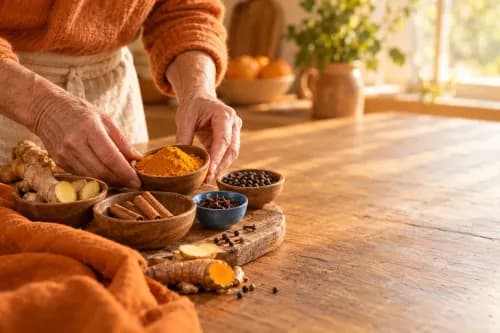
Curcumin is studied in osteoarthritis mainly because of its effects on inflammatory processes. In trials with people who have knee osteoarthritis, curcumin extracts were compared with placebo or with painkillers, usually measured with the WOMAC index. Several analyses report a small to moderate improvement in pain. Results for mobility and stiffness are inconsistent. The studies are small to medium in size, often last only a few weeks and use very different preparations. There is no authorised health claim for curcumin and joints.
Importantly, the studies do not show that curcumin cures osteoarthritis or rebuilds cartilage. The results concern symptoms, not the joint wear itself. Kitchen turmeric also contains only about 2 to 5 % curcumin, far below the amounts used in the trials.
Frequently asked questions about osteoarthritis
Is osteoarthritis the same as arthritis?
No. In osteoarthritis the wear of the cartilage is in the foreground, whereas arthritis refers to a primarily inflammatory joint disease, for example of rheumatoid type. The symptoms can look similar, but treatment differs.
What can you do yourself?
Exercise is considered an important building block, as is weight loss in case of excess weight, because it takes load off the joints. Which measures make sense for you is something to clarify with your doctor or a physiotherapist.
Does cartilage grow back?
Cartilage can regenerate only to a very limited extent. That is why osteoarthritis is considered incurable, although its course can be influenced. Claims that a supplement makes cartilage grow back are not supported.
What is activated osteoarthritis?
This is a flare in which the joint is additionally irritated: it swells, feels warm and hurts even at rest. Medical assessment is advisable then.
This entry explains a term and does not replace diagnosis or treatment. If you have joint complaints, talk to your doctor, especially before changing painkillers or adding supplements.