
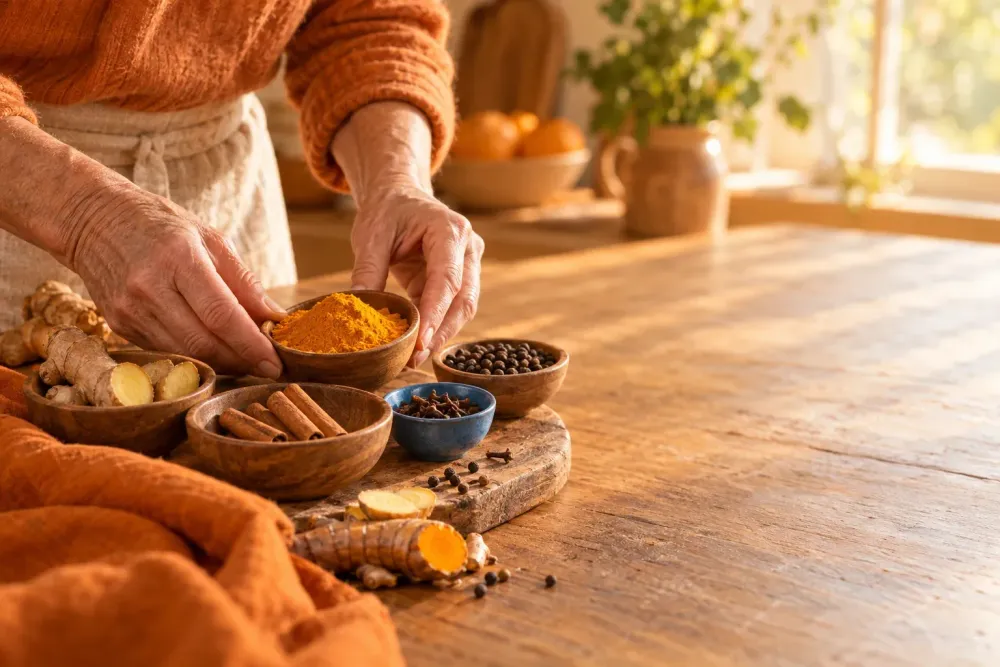
Hand on heart: how often have you heard of household remedies that are supposed to help against joint pain? Probably often. TV features and magazines suggest that reaching into the spice rack can replace ibuprofen.
So you stand in the kitchen, stir powder into your yogurt and hope. But deep inside you ask yourself: does this really do anything? Or am I just seasoning my cartilage wear?
As someone who has dug through the mountains of studies, I can tell you: it's complicated. Nature actually has a few extremely potent weapons against inflammation in its luggage. But there is a huge difference between "tastes good in curry" and "measurably relieves pain in the knee".
Let's get to the bottom of it and take a close look at the 5 spices. Which are real helpers and which rather fall under "faith moves mountains"?
The short answer (before the food gets cold)
Yes, research actually finds something – but the differences in efficacy are enormous. While for turmeric (curcumin) the evidence is now so overwhelmingly good that even conventional physicians nod in recognition, it looks thinner for other candidates. Ginger is a solid runner-up. The rest of the classic "osteoarthritis spices" (cumin, coriander, nutmeg) play, scientifically speaking, rather in the lower leagues, even if they are often praised traditionally.
Basic knowledge: Before we go into detail: if you want to know how inflammation in the joint arises in the first place and where natural substances act, take a look at our main curcumin article.
The check: the 5 spices in detail
Let's now look at the "Big 5" that are usually mentioned in the same breath as joint health.
1. Turmeric (the undisputed champion)
When we talk about spices against osteoarthritis, turmeric is the elephant in the room. Or rather: its active ingredient curcumin.
No other spice has been so intensively researched. Why? Because curcumin intervenes deeply in your body's biochemical processes. It blocks one of the central "master switches" for inflammation (the so-called NF-κB signaling pathway). When this switch is "off", fewer inflammatory messengers are produced that make your knee swell or your fingers stiff.
What studies say: The evidence is impressive. In several investigations (e.g. Kuptniratsaikul et al.) it was shown that curcumin extracts improve pain and mobility in knee osteoarthritis about as well as the painkiller ibuprofen – but with significantly fewer stomach problems [1]. Inflammatory markers in the blood also decreased measurably [2].
The catch: The yellow powder from the supermarket has a problem. It is extremely poorly water-soluble. Your body absorbs hardly any of it. To achieve the effects from the studies, you would have to eat unrealistic amounts. That's why successful studies almost always use optimized special extracts.
You can read more about this in our article specifically on turmeric for knee osteoarthritis.
2. Ginger (the pungent pursuer)
Ginger is botanically a cousin of turmeric. And it has similar talents. The pungent substances (gingerols and shogaols) act similarly to aspirin or ibuprofen by inhibiting certain enzymes (cyclooxygenases) that send pain signals.
What studies say: There is solid evidence that ginger extract makes a difference in osteoarthritis pain. The effects are usually moderate – so no "miracle healing", but noticeable relief. A meta-analysis showed that ginger reduced pain more than a placebo, even if the evidence is not quite as dense as for curcumin [3].
My advice: Ginger is great as a tea or in food, but too weak as a sole therapy for severe osteoarthritis. It is the perfect "wingman" for turmeric.
3. Cumin
Now we enter the realm of tradition. In Ayurvedic medicine, cumin is often used to promote digestion and flush out "toxins". Many popular "osteoarthritis spice blends" contain it.
The science on it: Here the air gets thin. There are hardly any clinical studies that have tested cumin in isolation for osteoarthritis in humans. We know that it acts as an antioxidant and can stabilize blood sugar (which is indirectly good for inflammation). But direct evidence for "less knee pain through cumin" is largely lacking. It doesn't harm, it tastes good – but don't expect miracles.
4. Coriander
Coriander polarizes – you love it or you hate it (does it also taste like soap to you?). In natural medicine it is considered anti-inflammatory and is often recommended for detoxification.
The science on it: Similar to cumin: the evidence is weak. There are animal studies showing that coriander-seed extract can reduce swelling [4]. But human studies proving a clear effect on joint wear have to be searched for with a magnifying glass. It is often part of blends, but rarely the main actor.
5. Nutmeg
Nutmeg is often traded in folk medicine as an "insider tip". Sometimes you read that a pinch is enough to lubricate joints.
The reality: Here I would advise caution. Yes, nutmeg contains substances that can influence pain. But nutmeg is toxic in higher doses (hallucinogenic and liver-damaging). The line between "effective" and "too much" is narrow. There are no large clinical studies proving that taking nutmeg for osteoarthritis is safe and effective. The anecdotal successes are often placebo or the result of the combination with other spices.
Spices in the study check
Comparison of the scientific evidence for various spices in osteoarthritis complaints.
| Spice | Evidence | Effect in osteoarthritis |
|---|---|---|
| Spice Turmeric | Evidence ⭐⭐⭐⭐ Very good | Effect in osteoarthritis Strong data for pain reduction (comparable to NSAIDs) [1] |
| Spice Ginger | Evidence ⭐⭐⭐ Good | Effect in osteoarthritis Moderate evidence of anti-inflammatory effects |
| Spice Cumin | Evidence ⭐ Weak | Effect in osteoarthritis Traditionally popular, hardly any specific osteoarthritis data |
| Spice Coriander | Evidence ⭐ Weak | Effect in osteoarthritis Often only investigated in blends, little individual evidence |
| Spice Nutmeg | Evidence ⚠️ Caution | Effect in osteoarthritis No controlled studies, dosing is tricky |
The rating is based on current clinical studies and meta-analyses.
The problem with the "kitchen dose"
Maybe you're now thinking: "Okay, then from today I'll cook curry every day." That's a tasty idea and certainly healthy. But to really achieve something with substantial osteoarthritis, that is usually not enough.
Why?
- Amount: Studies often use extracts that contain as much active ingredient as you can hardly eat with normal spice powders without feeling sick.
- Absorption: As mentioned above, turmeric is a "greasy lump" in a watery environment (your gut). Without biological help (such as piperine, micelles or cyclomaltooctaose), your body simply excretes 99% of the good stuff again.
I'll explain exactly why the formulations are so decisive in the article on bioavailability.
If you want to use spices as a supplement: concentrate on turmeric in a bioavailable form (e.g. micelles or cyclomaltooctaose) for the basic supply. Use ginger as a tea or in food as a daily companion. The other spices are culinarily top, but medically rather supporting actors.
Our recommendation: how to proceed
Don't let yourself be driven crazy by marketing promises trying to sell you "the one magic spice blend".
- The winner: If you had to choose only one remedy, take turmeric (curcumin). The evidence is by far the best here. But make sure not to buy simple powder, rather an extract with high bioavailability.
- The supplement: Ginger is a great addition. If you tolerate it, eat it fresh or take it as an extract alongside.
- The rest: See cumin and coriander as what they are: great foods that generally support your body, but no targeted osteoarthritis killers.
Nature offers help, but it needs the right dosage and patience. A spice doesn't work like a painkiller within 20 minutes. Give it 4 to 8 weeks.
Frequently asked questions (FAQ)
Only to a limited extent. The knee-osteoarthritis trials tested defined turmeric or curcumin extracts at about 1,000 mg of curcumin per day (Daily et al., 2016) DOI, not spice blends. According to a systematic review, the optimal dose, frequency and formulation are still unclear (Paultre et al., 2021) DOI. Whether a ready-made blend contains comparable amounts can therefore only be judged from the quantities stated on the label. Which ingredient of a blend might act cannot be inferred from studies of a single extract.
As a spice, yes, but you will not reach the amounts used in osteoarthritis trials this way. Pure turmeric powder averaged 3.14% curcumin in one analysis (Tayyem et al., 2006) DOI. The EMA lists a traditional intake of 0.5–1 g of powder, 2–3 times daily (EMA, 2018) EMA/HMPC/329755/2017, which works out to roughly 30–95 mg of curcumin per day (our own rough calculation). The trials used about 1,000 mg of curcumin per day (Daily et al., 2016) DOI. As mild side effects the EMA names dry mouth, flatulence and gastric irritation (EMA, 2018) EMA/HMPC/329755/2017.
The evidence is not the same, and head-to-head comparisons are missing. A meta-analysis of five trials (593 patients) found a moderate pain reduction with ginger in osteoarthritis (SMD −0.30) (Bartels et al., 2014) DOI. A later analysis in knee osteoarthritis, however, saw insufficient evidence for oral ginger capsules versus placebo (Araya-Quintanilla et al., 2020) DOI. For turmeric or curcumin, a review analysed eight RCTs, with advantages over placebo for pain and WOMAC (Daily et al., 2016) DOI. The studies used different scales, so the effects cannot be compared directly.
Read more
Want to dive deeper into the subject? Continue here:
- Turmeric for knee osteoarthritis: Why there is such good data specifically for the knee.
- Bioavailability: Why your body often ignores the powder.
- Curcumin cornerstone: Everything about the active ingredient and how it works.
References
- [1] Kuptniratsaikul, V. et al. (2009). Efficacy and safety of Curcuma domestica extracts in patients with knee osteoarthritis. J Altern Complement Med. DOI: 10.1089/acm.2008.0186
- [2] Panahi, Y. et al. (2016). Mitigation of Systemic Oxidative Stress by Curcuminoids in Osteoarthritis: Results of a Randomized Controlled Trial. J Diet Suppl. DOI: 10.3109/19390211.2015.1008611
- [3] Bartels, E.M. et al. (2015). Efficacy and safety of ginger in osteoarthritis patients: a meta-analysis of randomized placebo-controlled trials. Osteoarthritis Cartilage. DOI: 10.1016/j.joca.2014.09.024
- [4] Nair, V. et al. (2013). Anti-inflammatory activity of Coriandrum sativum seed extract. Pharm Biol.
