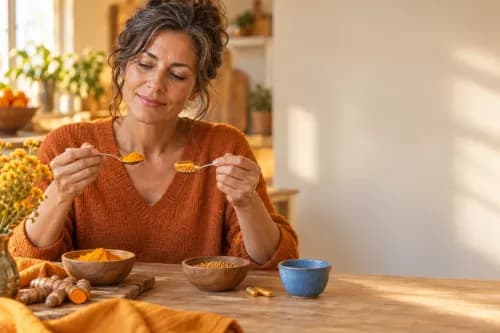
What Are Polyphenols?
Polyphenols (over 8,000 compounds) give blueberries their colour and protect plants from stress. Many of them act as antioxidants in lab tests; whether and how strongly this applies in humans depends on absorption and is unevenly documented.
Studied Effects
(Selected studies)
| Benefit | Mechanism | Evidence |
|---|---|---|
| Benefit Progenitor Cells | Mechanism Circulating angiogenic progenitor cells (CD34+/KDR+) about doubled | Evidence Heiss et al. 2010, J Am Coll Cardiol [PubMed 20620742]: 16 patients with coronary artery disease, 30 days of cocoa flavanols |
| Benefit Skin | Mechanism Skin roughness and skin elasticity improved versus placebo | Evidence Yoon et al. 2016, J Nutr: 24 weeks of cocoa flavanols (320 mg), randomised, placebo-controlled |
| Benefit Blood Pressure | Mechanism Systolic blood pressure about 4 mmHg lower than in the low-flavanol phase | Evidence Heiss et al. 2010 (see above): secondary finding in a small study of 16 patients |
| Benefit Hypertension | Mechanism No overall effect on incident hypertension | Evidence COSMOS trial (Harvard), cocoa extract |
Bioavailability Challenge
Standard curcumin is absorbed only to a very small extent. In a small pilot study (Purpura et al. 2018, 12 healthy adults, single dose, crossover), a γ-cyclodextrin formulation reached about 39 times more total curcuminoids and about 85 times more curcumin in the blood (AUC, dose-normalised) than an unformulated standard extract – without piperine.
In Our Products
- Curcumin+: 200 mg curcuminoids per daily serving in a γ-cyclodextrin complex.
"Polyphenols: the plant's own protection – and a reason why bioavailability matters."