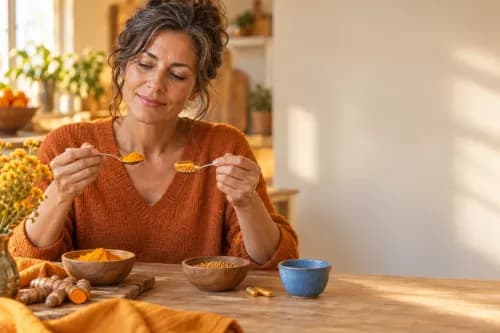
What does bioavailability mean?
Bioavailability describes what share of a compound reaches the bloodstream unchanged after intake and is available to the body. For drugs given directly into a vein it is 100 % by definition. For curcumin from ordinary turmeric powder it is very low, because the compound is poorly absorbed and quickly broken down.
Bioavailability explained simply
What you swallow is not automatically what your body can use. Between your mouth and your bloodstream there are several stations: the compound has to dissolve in the gut, cross the intestinal wall and must not be broken down straight away. Bioavailability describes how much is left at the end. It is usually given as a percentage or as a comparison (for example "ten times that of product X").
It is measured in pharmacokinetic studies: participants take the substance, then its concentration in the blood is determined over several hours. The area under this curve (AUC) lets researchers calculate the amount absorbed.
Why does bioavailability matter so much for curcumin?
Curcumin is considered the main active compound of the turmeric root, but it is a textbook example of poor bioavailability. Three hurdles work together:
- Solubility: curcumin is lipophilic, meaning fat-loving, and barely dissolves in the watery environment of the gut. It clumps together and is largely not absorbed.
- Uptake: the little that dissolves has to cross the gut wall (absorption).
- Breakdown: in the gut wall and liver curcumin is quickly converted and excreted (first-pass effect). The half-life of free curcumin is short in animal and cell experiments (in rat studies in the range of minutes; there is no reliable single value for humans).
Turmeric powder also contains only about 2 to 5 % curcumin. With plain powder, often less than 1 % of the compound reaches the blood. That is why studies usually work with extracts rather than the kitchen spice.
Ways to raise the bioavailability of curcumin
The factors come from the evidence as described in our articles. The figures are manufacturer claims or results from single studies and are not directly comparable with each other.
| Approach | Principle | Reported effect |
|---|---|---|
| Approach Fat with the meal | Principle bile acids form micelles that carry curcumin | Reported effect better than without fat, but does not solve the breakdown problem |
| Approach Piperine (black pepper) | Principle inhibits enzymes involved in breakdown | Reported effect about 20-fold higher in a small 1998 study (8 volunteers), later work found no significant effect; can also affect medication |
| Approach Micelles | Principle curcumin in a water-soluble shell | Reported effect up to 185-fold (AUC) versus native curcumin powder in one study of 23 adults |
| Approach Cyclodextrin complex | Principle curcumin inside a sugar ring, water-soluble | Reported effect about 39-fold (total curcuminoids) and 85-fold (curcumin), AUC, dose-normalised, versus an unformulated standard extract in a small pilot study of 12 healthy adults |
What bioavailability does not tell you
Higher bioavailability does not automatically mean a stronger effect. It only says that more of the compound reaches the blood. Whether that has a health effect has to be shown in separate studies. Multiples ("39-fold") also always refer to a comparison and depend on what is measured: total curcuminoids and curcumin behave differently.
For Curcumin+ we approached this by binding curcumin to γ-cyclodextrin in an inclusion complex, without piperine. In a small pilot study of a γ-cyclodextrin formulation (European Journal of Nutrition, 12 healthy adults, double-blind, crossover), the AUC (dose-normalised) for total curcuminoids was about 39 times and for curcumin about 85 times that of an unformulated standard extract. The study tested another manufacturer's commercial product made by a different process. Curcumin+ is made by the kneading method; there is no absorption study of Curcumin+ itself, so these figures cannot be transferred directly. That describes absorption, not an effect on any complaint.
Frequently asked questions about bioavailability
How high is the bioavailability of turmeric? With plain turmeric powder, often less than 1 % of the curcumin reaches the blood. Exact values depend on the preparation, the meal and the method of measurement.
What does "x-fold bioavailable" mean? It is a comparison against a reference product, usually from the AUC of a study in a few healthy people. Always ask: compared with what, and measured how?
Does more bioavailability mean more effect? Not automatically. It is the precondition for a compound to arrive at all, but it does not replace studies on effects. For other nutrients too, such as minerals, the form decides how well they are absorbed.