
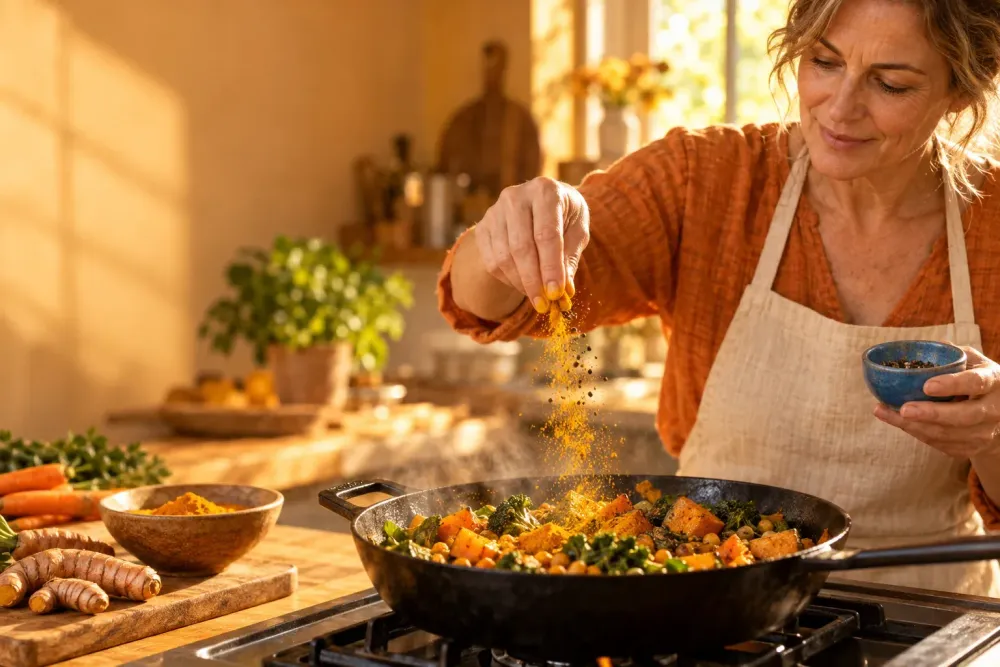
Imagine the following situation: you have read about this "miracle spice" in various health magazines. The golden root. The number-one anti-inflammatory. So you went out, bought a big bag of organic turmeric powder – or maybe those capsules from the drugstore – and now take them every morning.
You stir the powder into water, sprinkle it over your muesli or swallow the capsules. You wait. A week. A month.
And what happens?
Probably nothing.
Your knee still twinges when climbing stairs. The morning stiffness hasn't gotten one bit better. You ask yourself: "Was I mistaken? Is this all just marketing?"
I can reassure you: the problem is not you. And the problem is also not the curcumin itself. The stuff is biologically active – if it actually arrives where it's supposed to go. The bitter truth is: if you simply spoon up turmeric powder, almost none of it reaches your blood. It's like writing a letter but never putting it in the mailbox. It exists, but it doesn't reach its recipient.
Today we'll look at why that is – and above all, how you change it. We'll turn the letter into an express courier.
- Water-shy: Turmeric is fat-soluble. In your watery gastrointestinal tract it simply clumps together.
- The liver hurdle: Your liver recognizes curcumin as a foreign body and breaks it down extremely quickly.
- The result: With pure powder, often less than 1% of the active ingredient ends up in the blood.
Why your body resists turmeric
Let's get biochemical for a moment – but in a way we can understand without a doctorate. Curcumin (the substance we actually want) is a diva. Quite a prima donna, if you will.
There are basically three huge walls that the curcumin has to overcome to get from your mouth into your aching knee joint. And most standard products already fail at the first wall.
Barrier 1: The water problem (or: why salad dressing matters)
Think of a simple salad dressing of vinegar and oil. If you don't shake it vigorously, the oil floats on top. Water and oil don't like each other.
Your digestive tract is a very watery environment. Curcumin, however, is lipophilic – i.e. fat-loving [1]. If you now swallow dry powder or a capsule without fat, the curcumin doesn't even dissolve in the gut. It "floats on top", clumps together and simply slides through the digestive tract without ever penetrating the intestinal wall.
So it ends up where you need it least: in the toilet. Expensive urine (or rather stool), we call that.
Barrier 2: The instability
Even if a little bit dissolves, the next danger lurks. Curcumin is chemically unstable at a neutral or basic pH. As soon as it leaves the acidic stomach and reaches the small intestine (where the pH rises), it begins to break down. It decomposes into other substances before your body even has the chance to say "hello" [3].
Barrier 3: The metabolic hurdle (the liver)
This is the toughest nut. Let's say you've overcome barriers 1 and 2. A little curcumin has made it through the intestinal wall into the blood. The first stop for everything that comes from the gut is the liver.
And your liver is an extremely strict bouncer. It sees the curcumin, thinks "don't know you, doesn't belong here" and immediately marks it for exclusion. This process is called glucuronidation. The curcumin is made water-soluble and immediately thrown out again via the kidneys [1].
This happens so fast that the half-life of free curcumin is short in animal and cell experiments about 0.5 to 2 hours; Jäger et al., 2014. Far too short to migrate to the little toe or the knee and act on inflammatory processes there.
The 3 barriers to absorption
Water insolubility
Turmeric behaves like oil in water – it barely dissolves in the intestinal fluid and is not absorbed.
Instability
In the neutral environment of the small intestine, the molecule decomposes chemically before it can be absorbed.
Liver breakdown
What makes it into the blood is converted by the liver at lightning speed into ineffective breakdown products (first-pass effect).
The strategy: how to outwit the barriers
Okay, enough about the problems. You already have the powder at home. How do we get it into your body now? There are a few tricks from the kitchen and from chemistry that can help.
1. The fat rule (MANDATORY!)
If you take only one thing from this article, let it be this: never take turmeric on an empty stomach with just water.
Since curcumin is fat-soluble, you have to build it a taxi. And this taxi is made of fat. If you take turmeric with a fat-containing meal or a spoonful of oil, you stimulate the production of bile acids. These form small transporters (micelles) that enclose the curcumin and bring it to the intestinal wall.
Good fat sources:
- Coconut oil
- Olive oil
- Full-fat milk or yogurt
- Avocado
Studies show that absorption with fat is better than without – even if it doesn't solve the liver problem [2].
2. The pepper trick (the classic)
You may have heard of piperine. That's the pungent substance in black pepper.
Piperine is quite clever. It essentially distracts the bouncer. It inhibits exactly the enzyme in the liver that wants to break down curcumin. A famous study (already a bit older, from 1998) showed that adding piperine can increase the bioavailability of curcumin by 2000% [4]. That sounds gigantic – but unfortunately it turns "almost nothing" into still only "a little bit".
Still: if you use powder, always grind fresh black pepper with it.
Piperine inhibits the breakdown in the liver – this applies not only to curcumin, but also to medications!
- Risk: The effect of medications can be uncontrollably enhanced.
- Affected agents: E.g. blood thinners, antidepressants or other important medications.
- Important: Be sure to talk to your doctor about this!
3. Heat (the "golden milk" method)
In India, turmeric is often cooked for a long time in curries or drunk in warm milk. This is not just tradition, there's a reason for it. Mild heat can slightly improve the solubility of curcumin in water.
But caution: curcumin is considered heat-resistant below 120°C; at higher temperatures (such as during baking) partial thermal degradation occurs Hegde et al., 2023. A brief boil (as with golden milk) in a fatty liquid (almond milk with coconut oil) is well below that and is a good choice.

Masala Haldi Doodh (spiced golden milk variant)
Ingredients
- 1 cup of milk
- 1/2 tsp turmeric powder
- 1/2 tsp freshly grated ginger (or 1/4 tsp dried ginger powder)
- 1/4 tsp green cardamom powder (or 1 to 2 crushed pods)
- 1/8 tsp black pepper (freshly ground)
- 1/2 tsp ghee (optional, used in Ayurveda as a carrier for the active ingredients)
- 1 tsp jaggery or honey (optional)
Instructions Mix milk, turmeric, ginger, cardamom and black pepper in a pot. Simmer over medium heat for 3 to 5 minutes, taking care that the milk does not boil over. Remove from the heat, strain into a mug (if fresh ingredients were used) and stir in the ghee and the sweetener of your choice.
4. The quantity problem
Now I have to be honest with you. Even if you mix your powder with oil, add pepper and warm it: it remains difficult to reach study-based doses.
A normal turmeric powder from the supermarket contains only about 2–5% curcumin [1]. To reach the amounts used in successful osteoarthritis studies (often 500–1,000 mg of pure curcuminoid), you would have to eat tablespoons of spice daily. No stomach keeps that up for long.
For general health maintenance, the kitchen variant (golden milk) is great. But if you have concrete complaints – i.e. you really want to influence inflammatory parameters – pure powder is often like trying to put out a fire with a water pistol.
Which form is right for you?
It depends on what your goal is.
Scenario A: "I just want to stay healthy and like the taste." Stick with the powder!
- Recipe: Golden milk.
- When: In the evening (has a calming effect).
Scenario B: "I have pain and want to feel an effect." Here you will probably be disappointed with powder. You need a technology that bypasses the three barriers without you having to eat kilos of fat and pepper. In research, micelle technologies, phytosomes or cyclomaltooctaose have become established here. The curcumin is already packaged in the lab the way your body would otherwise laboriously attempt with fat – only much smaller and more stable. These forms often achieve a 39- to 185-fold bioavailability compared with the powder [5].
Intake strategies at a glance
Comparison of the effectiveness of different intake forms with regard to overcoming the biological barriers and actual absorption into the blood.
| Strategy | How does it work? | Who is it suitable for? |
|---|---|---|
| Strategy Powder + water | How does it work? Practically none. | Who is it suitable for? No one (a waste of money). |
| Strategy Powder + fat + pepper | How does it work? Improves dissolution & inhibits breakdown. | Who is it suitable for? Prevention & wellness. |
| Strategy Micelles/liquid | How does it work? Encloses curcumin in a water-soluble form. | Who is it suitable for? For higher bioavailability. |
| Strategy Phytosomes | How does it work? Binds curcumin to phospholipids. | Who is it suitable for? With a sensitive stomach. |
| Strategy Cyclomaltooctaose | How does it work? Ring structure makes curcumin water-soluble. | Who is it suitable for? Modern alternative without piperine. |
*Based on pharmacokinetic studies. Individual bioavailability can vary depending on metabolism and the quality of the preparation.
The key points again
We've learned: it's not your fault if the powder hasn't worked so far. Biology works a bit against us here.
- Never "naked": Turmeric needs fat to be absorbed.
- The pepper boost: Piperine helps slow the breakdown in the liver (caution with medications!).
- Realistic expectations: Supermarket powder is great for cooking and prevention. With concrete complaints, the dose and absorption are usually too low.
- The modern solution: If you're looking for noticeable effects at higher dosages, look at extracts with special transport systems (such as micelles or cyclomaltooctaose).
Feel free to experiment with golden milk – it's a wonderful ritual. But if your knee keeps twinging, you now know it might be time for the "heavy artillery".
Frequently asked questions (FAQ)
There is no evidence for a best time of day. A small feasibility study in obese adults compared turmeric in the morning versus the evening and found no differences in urine markers of oxidative stress; the turmeric treatment also did not show the expected antioxidant effect there (Blanton et al., 2020) DOI. Gastrointestinal complaints such as nausea or diarrhoea have been reported with turmeric (LactMed, 2025) PMID 30000906. Try what you tolerate well.
Not strictly, but curcumin from ordinary extract or powder is poorly absorbed: after 2 g of curcumin alone, human serum levels were undetectable or very low, whereas with 20 mg piperine bioavailability rose by 2000% (8 healthy volunteers) (Shoba et al., 1998) DOI. Special formulations also increase absorption: micellar curcumin 185-fold (Schiborr et al., 2014) DOI, a γ-cyclodextrin product (cyclomaltooctaose) 39-fold (Purpura et al., 2017) DOI compared with unformulated curcumin. These studies contain no direct comparison with piperine.
For flavour and seasoning yes; as a substitute for study doses no. Pure turmeric powder contained on average 3.14% curcumin in an analysis of 28 products, curry powder much less and highly variable (Tayyem et al., 2006) DOI. A 9-month study in prediabetes used 1,500 mg curcuminoids per day (Chuengsamarn et al., 2012) DOI; by calculation that would equal about 48 g of spice powder per day – not a usual seasoning amount. In addition, curcumin is poorly absorbed (Anand et al., 2007) DOI.
Read more
Want to dive deeper? Continue here:
- The big curcumin guide: Everything you need to know about effects, studies and background.
- Piperine vs. micelles: Which technology is really worth its money?
- Turmeric for knee osteoarthritis: A concrete plan for how to support your joints.
- Safety first: When you should be careful when taking it (interactions).
References
- [1] Anand, P. et al. (2007). Bioavailability of curcumin: problems and promises. Molecular Pharmaceutics. DOI: 10.1021/mp700113r
- [2] Dei Cas, M. & Ghidoni, R. (2019). Dietary Curcumin: Correlation between Bioavailability and Health Potential. Nutrients. DOI: 10.3390/nu11092147
- [3] Nelson, K. M. et al. (2017). The Essential Medicinal Chemistry of Curcumin. Journal of Medicinal Chemistry. DOI: 10.1021/acs.jmedchem.6b00975
- [4] Shoba, G. et al. (1998). Influence of piperine on the pharmacokinetics of curcumin in animals and human volunteers. Planta Medica. DOI: 10.1055/s-2006-957450
- [5] Schiborr, C. et al. (2014). The oral bioavailability of curcumin from micronized powder and liquid micelles is significantly increased in healthy humans and differs between sexes. Molecular Nutrition & Food Research. DOI: 10.1002/mnfr.201300724
