
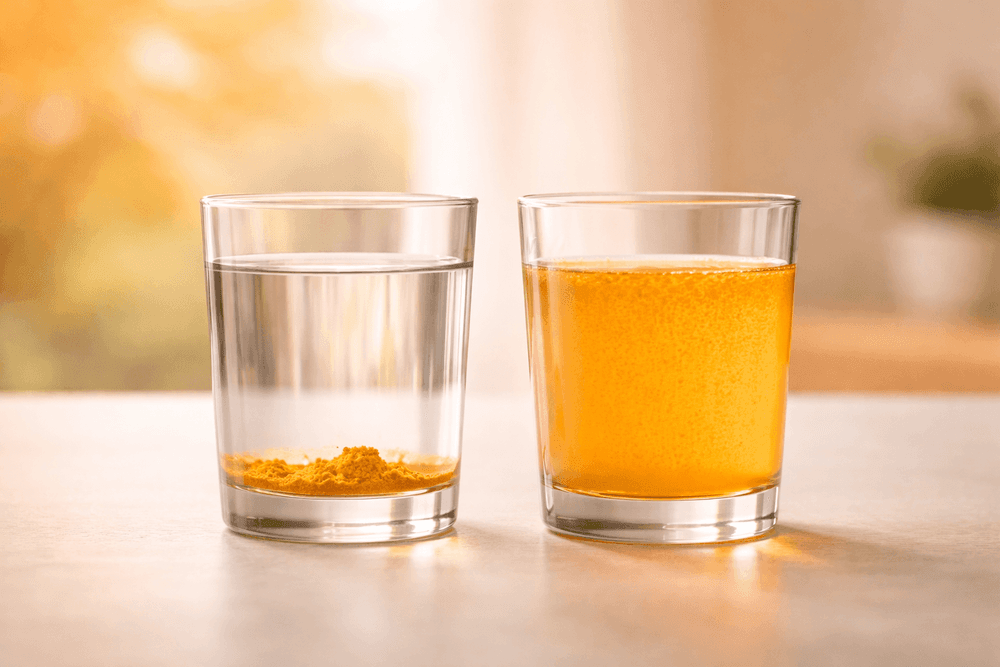
The Bioavailability Paradox of Curcumin: Physiological Barriers and Technological Solutions
Curcumin, the primary polyphenol in turmeric (Curcuma longa), is one of the most intensively studied plant molecules in biomedical research. In preclinical models, many biochemical effects are described — including effects on inflammation-related pathways (e.g., NF-κB) and oxidative processes. [15]
In clinical reality, however, there is one central issue: the bioavailability paradox. This refers to the gap between promising in-vitro effects and very low systemic availability after oral intake. Reviews and pharmacokinetic research have described for years that standard curcumin is only detectable to a limited extent as “free” curcumin in blood after ingestion, because absorption, stability, and metabolism limit it at the same time. [1][7][14]
This article explains:
- why oral curcumin reaches the body so poorly,
- which physiological barriers matter most,
- and which formulation strategies have been shown in human studies to measurably increase bioavailability (e.g., piperine, phytosomes, micelles, gamma-cyclodextrin). [3][17][18][20]
Key Facts (Quick Summary)
- Extremely poor water solubility: Curcumin is highly lipophilic (fat-loving) and dissolves poorly in the watery environment of the digestive tract — slowing absorption from the very start. [1][15]
- Chemical instability: Under conditions that can occur in the small intestine, curcumin can break down relatively quickly (degradation) before it is even absorbed. [20]
- Fast first-pass metabolism: The small fraction that is absorbed is rapidly converted in the gut wall and liver into glucuronides and sulfates (conjugation). [10][14]
- Formulations change the equation: Human studies show that carrier systems (e.g., micelles, phytosomes, cyclodextrins) and bioenhancers (e.g., piperine) can significantly increase PK parameters (AUC/Cmax) in some cases. [3][17][18][20]
- “More in the blood” ≠ automatically “more effect”: Many measurements capture total curcuminoids and/or metabolites. Which forms matter in which tissues is scientifically complex and not fully settled. [7][14]
What does “bioavailability” mean for curcumin?
In pharmacology, bioavailability describes the share of a substance that becomes available in the systemic circulation after ingestion. For curcumin, this is typically evaluated using two key metrics:
- Cmax: the maximum concentration in blood plasma
- AUC (Area Under the Curve): overall exposure over time (simplified: “how much was available in total?”)
Across many reviews, standard curcumin has low oral bioavailability — mainly due to poor solubility, limited stability, and rapid metabolism. [1][7][14]
Physiological barriers: Why the body “slows down” curcumin
Absorption is typically limited by four factors: solubility, instability, metabolism, and efflux.
The solubility problem (lipophilicity)
Curcumin is hydrophobic (water-repelling). In a mostly watery environment — like intestinal contents — curcumin only dissolves to a limited extent. Without being sufficiently dissolved, it has a harder time reaching and passing through the intestinal wall. [1][15]
In simple terms: Many substances are absorbed well only when they are dissolved in the gut lumen. Being “fat-loving” becomes a disadvantage if there is no suitable carrier present. [1]
Chemical instability and pH effects
Curcumin can degrade under physiological conditions. Especially in neutral to slightly basic environments — conditions that can occur in the small intestine — mechanistic research describes accelerated degradation. [20]
Why this matters: Anything that chemically breaks down can no longer be absorbed as intact curcumin — so the available “starting amount” drops even further. [20]
First-pass metabolism (gut wall & liver)
Even if curcumin crosses the intestinal wall, it is quickly transformed:
- Phase I (e.g., reduction) → including dihydro-/tetrahydro-metabolites
- Phase II (conjugation) → mainly glucuronidation and sulfation
As a result, blood measurements often show mostly conjugates, while free curcumin appears only in small amounts. [10][14][16]
In simple terms: Glucuronides/sulfates are more “water-friendly” and are easier to excrete — this is the body’s detox mechanism for foreign compounds. [10][14]
P-glycoprotein efflux
Another “filter” involves efflux transporters like P-glycoprotein (P-gp). These transporters can move substances out of enterocytes (intestinal cells) back into the gut lumen, reducing net absorption. [15][21]
Barriers and solution strategies at a glance
Metabolism (liver/gut)
Curcumin is rapidly conjugated (glucuronidation/sulfation) and therefore excreted faster.
Bioenhancers (e.g., piperine)
Can influence metabolism/transport; one human study reported a strong PK increase.
Water insolubility
Curcumin dissolves only poorly in the gut lumen — without a carrier system, absorption drops.
Carrier systems
Micelles, phytosomes, or cyclodextrins improve “compatibility” with watery environments and membranes.
Technological approaches and what studies show
The goal of modern formulations is to address at least one barrier: improved solubility, greater stability, reduced breakdown, or more efficient uptake.
First generation: piperine as a bioenhancer
A classic approach is combining curcumin with piperine (from black pepper). Piperine is discussed as a bioenhancer that can influence enzyme systems and transport processes. [20][21]
- Evidence: In Shoba et al. (1998), combined intake of curcumin + piperine was linked to a clearly higher curcumin exposure (often reported as “~20x/2000%”). [20]
- Interpretation: Piperine mainly targets metabolism/transport, not the basic solubility problem. And with bioenhancers, potential interactions always need consideration (especially with medications). [21]
Second generation: lipid/phospholipid systems & micelles
This includes phytosomes (phospholipid complexes) and micellar systems (encapsulation in carrier structures).
Phytosomes (phospholipid complexes):
- Idea: Curcumin is bound to phospholipids, which may make membrane passage easier. [3]
- Evidence: Cuomo et al. (2011) reported clearly higher absorption/exposure of a lecithin formulation versus standard curcumin. [3]
Micelles (e.g., polysorbate-based systems):
- Idea: Lipophilic molecules are “packed” into very small carrier systems that remain stable in watery environments. [18]
- Evidence: In Schiborr et al. (2014), a micellar formulation showed a very strong increase in PK parameters (AUC) compared to native/micronized forms. [18]
- Interpretation: These results are impressive — but strongly depend on study specifics (design, analytics, endpoints, metabolite profiles). [18]
Third generation: cyclodextrins & other hydrophilic carrier systems
Newer approaches aim to make curcumin more water-compatible without classic surfactant micelles.
Gamma-cyclodextrin:
Cyclodextrins are ring-shaped oligosaccharides with a hydrophobic inner cavity and a hydrophilic outer surface. Curcumin can be enclosed as a “guest.” [17][26]
- Evidence: In Purpura et al. (2018), a gamma-cyclodextrin formulation showed a clearly increased relative bioavailability versus standard curcumin. [17]
Formulation-dependent PK (crossover data):
More recent human crossover studies also show a general pattern: pharmacokinetics depend strongly on the formulation, not only on the mg number printed on the label. [6]
Comparison of clinical studies on bioavailability
Overview of pharmacokinetic human studies that directly compare different formulations.
| Study | Formulation / strategy | Dose (curcuminoids) | Result (relative bioavailability) |
|---|---|---|---|
| StudyShoba et al. (1998) | Formulation / strategyCurcumin + piperine | Dose (curcuminoids)2000 mg | Result (relative bioavailability)strong PK increase vs. curcumin alone (often reported as ~20x) [20] |
| StudyCuomo et al. (2011) | Formulation / strategyPhospholipid formulation (phytosome) | Dose (curcuminoids)~376 mg | Result (relative bioavailability)higher absorption/exposure vs. standard curcumin [3] |
| StudySchiborr et al. (2014) | Formulation / strategyMicelles | Dose (curcuminoids)410 mg | Result (relative bioavailability)very strong AUC increase vs. native powder [18] |
| StudyPurpura et al. (2018) | Formulation / strategyGamma-cyclodextrin | Dose (curcuminoids)~376 mg | Result (relative bioavailability)clearly increased relative bioavailability vs. standard [17] |
| StudyFança-Berthon et al. (2021) | Formulation / strategyFormulation crossover (PK) | Dose (curcuminoids)variable | Result (relative bioavailability)PK depends significantly on formulation [6] |
1) AUC = Area Under the Curve. 2) Relative factors are more meaningful within a study than as a “ranking” across studies. 3) Differences in analytics and metabolite profiles can distort comparisons.
Brief analysis of key studies (short, but solid)
Study: Micelles vs. powder (Schiborr et al., 2014)
Crossover design; comparison of native curcumin, micronized powder, and micellar form. [18]
- Result: The micellar formulation showed the highest exposure (AUC) in this study setting. [18]
- Editorial interpretation: PK advantage — yes. But clinical value depends on whether higher blood levels matter for specific target outcomes. [7][18]
Study: Cyclodextrin in a formulation comparison (Purpura et al., 2018)
Comparison of several innovative formulations in humans. [17]
- Result: Gamma-cyclodextrin showed high relative bioavailability vs. standard curcumin. [17]
- Interpretation: Hydrophilic carriers can improve solubility/transport without requiring classic surfactants. [17][26]
Study: Dose efficiency of modern matrices (Kothaplly et al., 2022)
Tested a newer formulation under fasting conditions; reported higher PK parameters versus standard extract at a lower dose. [12]
- Interpretation: Results like this support the rule: “Formulation beats mg number.” But clinical relevance must still be evaluated separately depending on the goal. [7][12]
Safety and limitations
Reviews and clinical literature often describe curcumin as generally well tolerated; at higher doses, the most common reports involve gastrointestinal effects (e.g., nausea, diarrhea, stool color changes). [7][9]
At the same time: the more bioavailability is increased, the more important it becomes to evaluate potential interactions, especially when bioenhancers are used and/or medications are taken regularly. [21]
Important note on interactions & highly bioavailable formulations
Modern curcumin formulations can produce much higher blood levels than standard extracts.
That can be beneficial from a pharmacokinetic perspective — but it may also increase the risk and relevance of interactions, especially if taken alongside:
- anticoagulants / antiplatelet agents (blood thinners)
- medications with a narrow therapeutic window
Medical disclaimer: This article is not a substitute for medical advice.
Conclusion
Curcumin’s bioavailability paradox is physiologically plausible and well documented: poor water solubility, chemical instability, and rapid metabolism often prevent meaningful systemic levels from standard curcumin. [1][14][20]
Human studies also show clearly: formulation strategies can strongly increase bioavailability — depending on the approach, via bioenhancers (piperine), phospholipid complexes (phytosomes), micelles, or cyclodextrins. [3][17][18][20]
For evaluating curcumin products, this means:
The mg amount alone is not a reliable quality indicator. What matters is how well a formulation overcomes absorption barriers — and which human data exist for that formulation. [6][7][18]
FAQ: Common questions about curcumin bioavailability
1. Why is normal turmeric powder absorbed so poorly? Curcumin is lipophilic and poorly soluble in the watery gut lumen. In addition, it is rapidly metabolized after absorption. [1][14]
2. What is the difference between Cmax and AUC? Cmax is the highest blood level. AUC describes total exposure over time — both are standard parameters used to evaluate bioavailability. [7][18]
3. Is very high bioavailability automatically better? It first means higher exposure (PK). Whether that translates into clinically relevant benefit depends on the goal and the evidence for outcomes. [7]
4. Does oil help when taking curcumin? A fatty meal can support absorption of lipophilic compounds — but in studies, special formulations typically reach much higher PK values than “fat only.” [1][18]
5. Why is piperine added? Piperine can increase curcumin exposure, likely via effects on metabolism/transport. At the same time, interactions must be considered in principle. [20][21]
References
- Anand, P. et al. Bioavailability of curcumin: problems and promises. Molecular Pharmaceutics (2007). DOI: 10.1021/mp700113r.
- Arora, R. et al. Curcumin Loaded Solid Lipid Nanoparticles Ameliorate Adjuvant-Induced Arthritis in Rats. Eur. J. Pain (2015). DOI: 10.1002/ejp.620.
- Cuomo, J. et al. Comparative absorption of a standardized curcuminoid mixture and its lecithin formulation. Journal of Natural Products (2011). DOI: 10.1021/np1007262.
- Dei Cas, M. & Ghidoni, R. Dietary Curcumin: Correlation between Bioavailability and Health Potential. Nutrients (2019). DOI: 10.3390/nu11092147.
- El-Saadony, M.T. et al. Impacts of turmeric and its principal bioactive curcumin on human health: Pharmaceutical, medicinal, and food applications: A comprehensive review. Frontiers in Nutrition (2023). DOI: 10.3389/fnut.2022.1040259.
- Fança-Berthon, P. et al. Pharmacokinetics of a Single Dose of Turmeric Curcuminoids Depends on Formulation: Results of a Human Crossover Study. The Journal of Nutrition (2021). DOI: 10.1093/jn/nxab087.
- Gupta, S.C. et al. Therapeutic Roles of Curcumin: Lessons Learned from Clinical Trials. The AAPS Journal (2013). DOI: 10.1208/s12248-012-9432-8.
- Hegde, M. et al. Curcumin Formulations for Better Bioavailability: What We Learned from Clinical Trials Thus Far? ACS Omega (2023). DOI: 10.1021/acsomega.2c07326.
- Hewlings, S.J. & Kalman, D.S. Curcumin: A Review of Its Effects on Human Health. Foods (2017). DOI: 10.3390/foods6100092.
- Ireson, C.R. et al. Metabolism of the cancer chemopreventive agent curcumin in human and rat intestine. Cancer Epidemiology, Biomarkers & Prevention (2002). PMID: 11895858.
- Jäger, R. et al. Comparative absorption of curcumin formulations. Nutrition Journal (2014). DOI: 10.1186/1475-2891-13-11.
- Kothaplly, S. et al. Superior Bioavailability of a Novel Curcumin Formulation in Healthy Humans Under Fasting Conditions. Advances in Therapy (2022). DOI: 10.1007/s12325-022-02081-w.
- Liu, W. et al. Oral bioavailability of curcumin: problems and advancements. Journal of Drug Targeting (2016). DOI: 10.3109/1061186X.2016.1157883.
- Metzler, M. et al. Curcumin uptake and metabolism. BioFactors (2013). DOI: 10.1002/biof.1042.
- Nelson, K.M. et al. The Essential Medicinal Chemistry of Curcumin. Journal of Medicinal Chemistry (2017). DOI: 10.1021/acs.jmedchem.6b00975.
- Pan, M.H. et al. Biotransformation of curcumin through reduction and glucuronidation in mice. Drug Metabolism and Disposition (1999). PMID: 10101144.
- Purpura, M. et al. Analysis of different innovative formulations of curcumin for improved relative oral bioavailability in human subjects. European Journal of Nutrition (2018). DOI: 10.1007/s00394-016-1376-9.
- Schiborr, C. et al. The oral bioavailability of curcumin from micronized powder and liquid micelles is significantly increased in healthy humans and differs between sexes. Molecular Nutrition & Food Research (2014). DOI: 10.1002/mnfr.201300724.
- Scazzocchio, B. et al. Interaction between Gut Microbiota and Curcumin: A New Key of Understanding for the Health Effects of Curcumin. Nutrients (2020). DOI: 10.3390/nu12092499.
- Shoba, G. et al. Influence of piperine on the pharmacokinetics of curcumin in animals and human volunteers. Planta Medica (1998). DOI: 10.1055/s-2006-957450.
- Stohs, S.J. et al. Highly Bioavailable Forms of Curcumin and Promising Avenues for Curcumin-Based Research and Application: A Review. Molecules (2020). DOI: 10.3390/molecules25061397.
- Urošević, M. et al. Curcumin: Biological Activities and Modern Pharmaceutical Forms. Antibiotics (2022). DOI: 10.3390/antibiotics11020135.
- Yallapu, M.M. et al. Therapeutic Applications of Curcumin Nanoformulations. The AAPS Journal (2015). DOI: 10.1208/s12248-015-9811-z.